Boxes
How to choose a shipping box: size, strength and style
A box does three jobs: it holds the item, it survives the trip and it decides part of the shipping price. Getting all three right comes down to size, board strength and shape. Here is how to choose, with figures from the 62 standard Tape Logic boxes and the rest of the 62 sizes in the box range.
Measure the item first
Start with a tape measure, not a catalog. Measure the item at its longest, widest and tallest points, including anything that sticks out, such as a handle or a plug. Write the three numbers down in the same order you will read box sizes: length, width, height. Box sizes are inside dimensions, the space the item actually gets.
Then add room for protection. A sturdy item that cannot break, such as a folded shirt or a paperback, needs only enough space to go in without forcing the flaps. Anything fragile needs a layer of cushioning on every side, usually about 2 inches, so the box should be about 4 inches larger than the item in each direction. A box that is too tight transfers every knock straight to the contents. A box that is too loose lets the item build up speed before it hits a wall.
“Use strong packaging with enough room to add cushioning for fragile items and to prevent items from shifting.”
The Postal Service's packing advice describes the goal well: strong packaging with enough room for cushioning and to stop items from shifting. It also reminds shippers that a parcel rides through automated machines next to packages that can weigh as much as 70 pounds, which is a good picture to keep in mind when deciding how strong the box needs to be.
If the item is an odd shape, measure the smallest rectangle it fits into and work from that. Long, thin items and tall items usually waste less space in long or tall boxes than in a standard cube, and flat items fit flat boxes better.
What 200#/ECT-32 means on the bottom flap
Most American shipping boxes carry a round stamp on the bottom flap called the box maker's certificate. It names the board grade, and that grade is the best single guide to how much a box can take. On most everyday boxes it reads 200# burst or 32 ECT, and the Tape Logic box specs give both: 200#/ECT-32 kraft corrugated.
The two numbers measure different things. Burst strength, given in pounds per square inch, is the pressure it takes to punch through the board, which relates to rough handling and puncture. ECT stands for edge crush test, measured in pounds per inch. It is the force the board takes on its edge before it crumples, and it predicts how well a box resists being stacked under others. They are not interchangeable ratings, but a 200# box and a 32 ECT box are the usual pairing for single wall board.
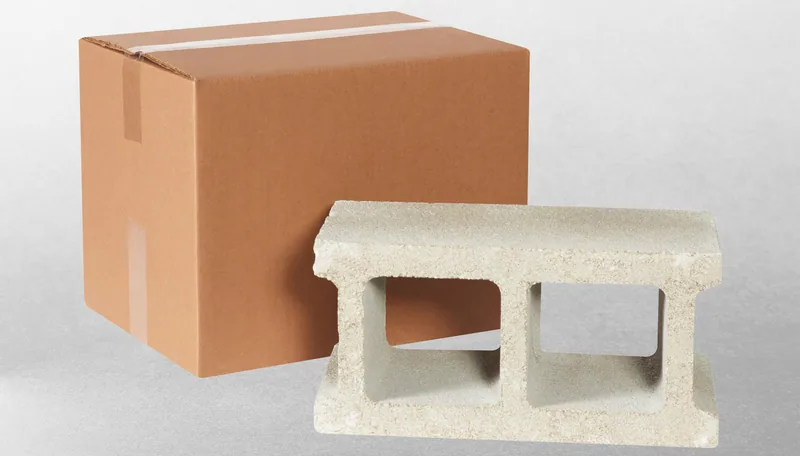
The grade goes up with weight. Across the Tape Logic lineup, most standard, flat, long, tall and multi-depth boxes are 200#/ECT-32 single wall, which the boxes rate for contents up to 65 pounds. Some side-loading and moving boxes step up to 275#/ECT-44. The heavy-duty boxes are double wall, mostly 275# ECT-48, with ECT-51 on some sizes, for heavy loads and stacking on pallets.
The jump from ECT-32 to double wall roughly doubles the protection and adds cost, so it is worth paying for only when the contents are heavy, the box will be stacked, or the item is valuable enough that a crushed corner would be expensive.
| Board grade | Models | Lines | Lowest price per box |
|---|---|---|---|
| 200# / ECT-32 | 150 | Flat Boxes, Long Boxes, Tall Boxes, Multi-Depth Boxes… | 81¢ |
| 275# / ECT-44 | 10 | Side-Loading Boxes, Insulated & Specialty Shipping Boxes, Moving Boxes | $6.56 |
| ECT-48 | 13 | Heavy-Duty Boxes, Moving Boxes | $4.98 |
| ECT-51 | 1 | Heavy-Duty Boxes | $11.68 |
| 350# / ECT-51 | 1 | Insulated & Specialty Shipping Boxes | $9.50 |
Single wall or double wall
Corrugated board is a sandwich: a wavy layer of paper, the fluting, glued between flat liners. Single wall board has one layer of fluting. Double wall board has two, with a third liner in the middle, which makes it thicker, stiffer and much better at resisting crushing.
For most parcels, single wall is enough. A box of clothes, books in small quantities, toys, kitchenware wrapped in paper: these travel well in 200#/ECT-32 single wall boxes, which are light, cheap and easy to fold. Single wall also keeps the parcel weight down, which matters when postage is charged by weight.
Double wall earns its place in four cases: heavy contents, boxes that will sit at the bottom of a stack, long trips with several handoffs, and items that cannot take a dent. The Tape Logic heavy-duty boxes describe themselves as twice the protection of a standard carton, and buyers who use them for books, tools and vinyl records say the same in their reviews. Others note the flip side: they cost more per box, so they are wasted on light items.
One practical test helps. Pack the box, close it and press down on the center of the top with one hand. If it gives noticeably, or the sides bow out, the box is either too weak for the load or too large for it. Moving to double wall or a smaller box fixes both problems.
In the catalog
Shapes: standard, flat, long, tall and the rest
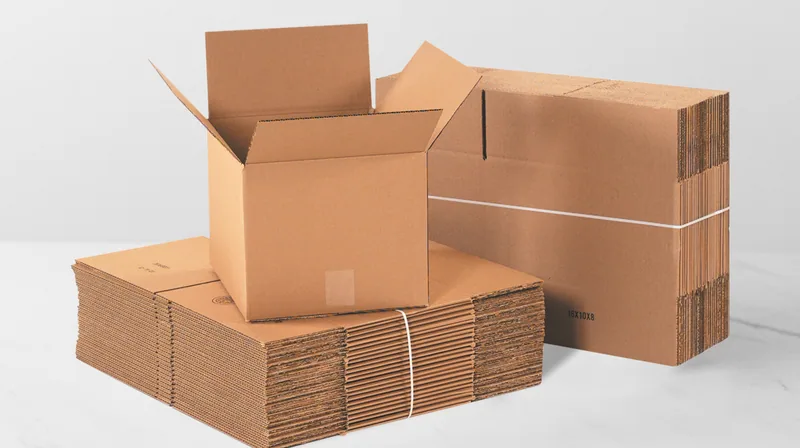
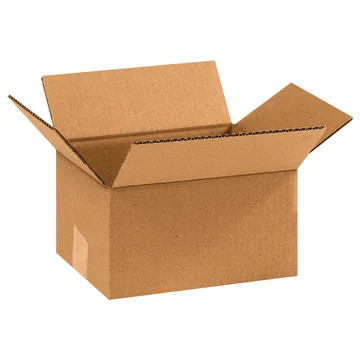
The standard box, the regular slotted carton with four flaps top and bottom, covers most shipments. It comes in many sizes, ships flat and folds in seconds. Tape Logic's standard boxes start at 9 x 7 x 5 inches and run up to large cartons. When an item is close to a cube, this is the box.
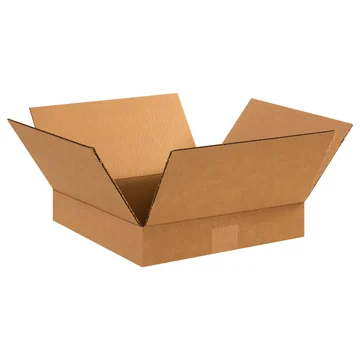
Flat boxes are shallow, usually 2 to 6 inches deep, for items that are wide but thin: folded clothing, books, printed material, picture frames and mirrors. A shallow box fits these items snugly, so nothing slides, and the parcel stays small. Flat boxes are the most-rated Tape Logic line, with 4.6 out of 5 from 1,798 ratings.
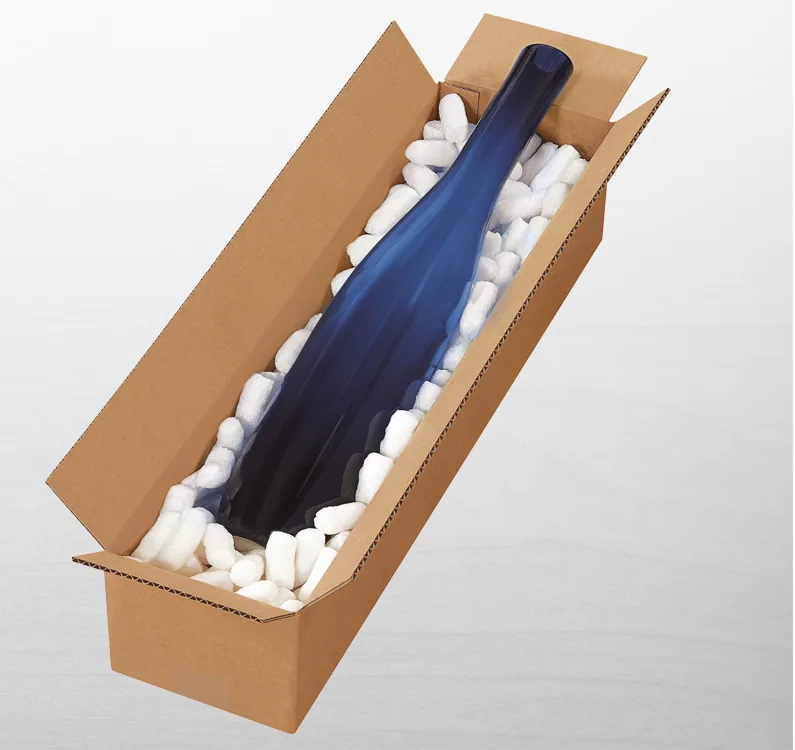
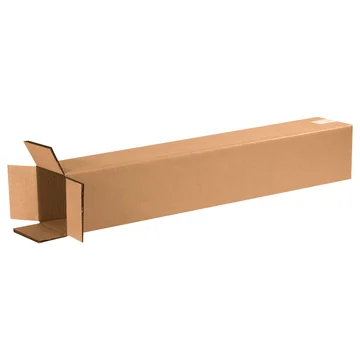
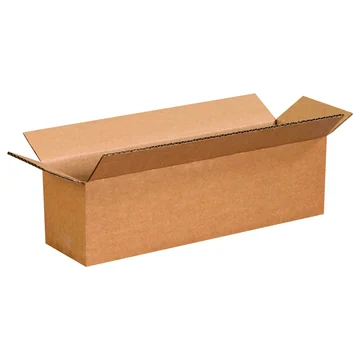
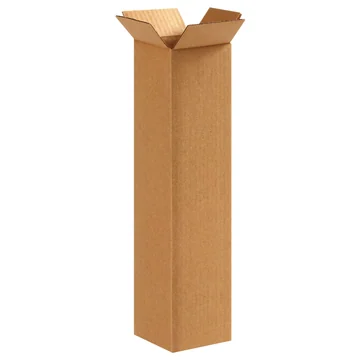
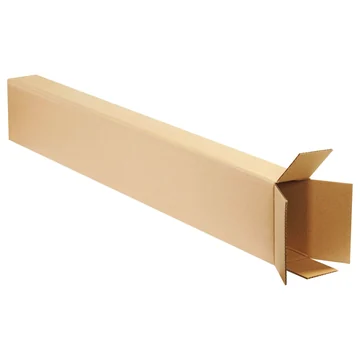
Long boxes and tall boxes handle narrow items. A long box opens along its length, so a rod or lamp drops in from above. A tall box loads from the end, standing upright, and can replace a mailing tube for posters. Telescoping boxes go further: an inner and an outer piece slide together, so the length adjusts to the item. Side-loading boxes open along the long side for frames, mirrors and art, with full overlap flaps that add a second layer of board where they close.
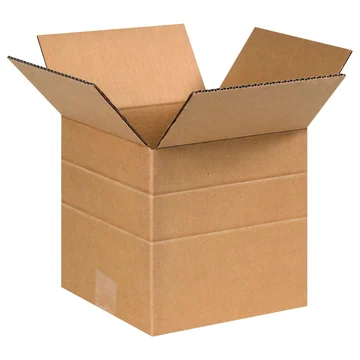
Multi-depth boxes are a clever middle ground. They are scored at intervals around the sides, so you cut the corners down to the height you need and fold the flaps there. One box covers several heights, which saves shelf space and helps fit each order without extra filling.
| Style | Sizes | Boxes per bundle | Lowest price per box |
|---|---|---|---|
| Flat Boxes | 31 | 5–25 | $1.63 |
| Long Boxes | 32 | 10–25 | $1.30 |
| Tall Boxes | 33 | 10–25 | $1.35 |
| Multi-Depth Boxes | 33 | 10–25 | $1.60 |
| Standard Corrugated Boxes | 62 | 5–100 | $1.11 |
| Side-Loading Boxes | 12 | 5–20 | $5.42 |
| Heavy-Duty Boxes | 21 | 5–15 | $3.14 |
| Insulated & Specialty Shipping Boxes | 7 | 8–50 | 81¢ |
| Moving Boxes | 5 | 5–10 | $12.93 |
In the catalog
A starter set of boxes for a small shop
Most small shops ship a handful of product types again and again, and the right box stock follows those products rather than a catalog page. Write down the five items you ship most, measure each one with its packaging, and pick the smallest standard box that fits each with the cushioning it needs. Very often two or three sizes cover most orders.
Add one or two multi-depth boxes for the awkward orders: two items instead of one, an item with a gift insert, a bundle. A multi-depth box cut down to the order's height does the job of several stock sizes. Add a flat box if you ship clothing or books, and a long box if any product is longer than about 18 inches.
Buy in bundles that match your monthly volume. A bundle of 25 standard boxes is a sensible start for most sizes. The most-used size may justify a larger bundle once you know your numbers. Keep a note of the model numbers so a reorder brings the same box, with the same fit, every time.
Finally, keep a few heavy-duty double wall boxes on hand for the occasional heavy or valuable order. They cost more, but one saved breakage pays for several of them.
In the catalog
Packing common items: books, dishes, electronics, clothing
Books are heavy for their size, so the mistake is a box that is too big. A box full of books can reach a weight that splits a single wall box at the seams. Use small boxes, or double wall for anything more than a few books, pack the books flat or upright with no gaps, and tape the bottom with the H pattern. A flat box fits one or two books snugly.
Dishes and glassware need space and separation. Wrap each piece in paper, stand plates on edge rather than flat, and fill every gap so nothing touches another piece. A double wall box gives the walls more stiffness, and the Tape Logic moving range includes a kitchen dish pack partition kit that keeps pieces apart. Mark the box Fragile on the top and on the sides.
Electronics combine weight, fragile parts and sensitivity to static. Use the original box inside a larger shipping box if you still have it, with cushioning between the two. If not, wrap the item in anti-static material, cushion every side and keep the item from moving. Labels such as Electrostatic Sensitive Devices tell handlers what is inside.
Clothing is the easy case. It does not break, so a flat box or a poly mailer is enough, and the smallest package that fits keeps the shipping cost down. A flat box looks tidier and protects folded shirts from creasing. A mailer weighs less.
In the catalog
Long, tall and awkward items
Narrow items are the most common reason people pay to ship air. A fishing rod in a cube is mostly empty box, which costs postage and lets the rod slide. Long boxes and tall boxes solve this by matching the box's shape to the item's shape, and the difference in volume can be large.
Use a long box when the item lies flat along its length and you want to drop it in from above: rods, tools, light fixtures, tumblers in a row, rolled rugs. Use a tall box when you want to slide the item in from one end: golf clubs, posters, umbrellas, floor lamp poles. Tall boxes also do not roll, so many shippers use them in place of mailing tubes.
If the item's length varies, telescoping boxes adjust: an inner and an outer piece slide over each other, and you tape them at the length you need. They are sold separately, so you buy one inner and one outer for each set.
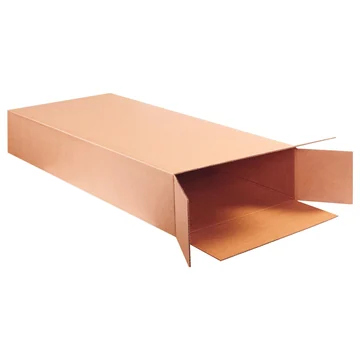
Wide, flat items such as framed art and mirrors go into side-loading boxes, which open along the long side so the item slides in flat. Their full overlap flaps add a second layer of board along the opening, the weakest point of most boxes. Protect the corners of a frame with cardboard corners or extra paper before it goes in.
In the catalog
Boxes for moving a home
A home move uses more boxes than most people expect, and the right mix matters more than the total. Small boxes take books, tools and anything heavy, so no single box becomes too heavy to lift safely. Medium boxes take kitchen goods, toys and most household items. Large boxes take bedding, pillows and light, bulky things. Keep the heavy items in the small boxes. A large box full of books is hard to carry and likely to fail.
Moving boxes take more abuse than shipping boxes, because they are stacked in a truck and carried by hand. The Tape Logic moving range uses heavy-duty 275#/ECT-44 board and double wall on the extra-large boxes, plus side-loading boxes for mirrors, frames and flat screens, and wardrobe hanger bars that turn a tall box into a closet on the move.
Label each box on the top and on two sides with the room it goes to, and add Fragile and arrow labels where they apply. A row of boxes stacked against a wall shows only its sides, so a label on the top alone is often hidden. Tape every box top and bottom. Moving boxes are lifted from below, and an untaped bottom is the most common moving accident.
Plan on more tape than you think. One 55 yard roll seals roughly 15 to 20 medium boxes with a single strip top and bottom, and about half that with the H pattern, so a move of 60 boxes can easily use five or six rolls.
Why a smaller box can cost less to ship
Carriers do not charge by weight alone. For most parcels they also work out a dimensional weight from the size of the box, by multiplying length, width and height and dividing by a factor each carrier publishes. The parcel is billed at whichever is higher, the real weight or the dimensional weight. A big, light box can cost as much to ship as a small, heavy one.
That makes box size one of the few shipping costs you control. An inch off each side of a box shrinks its volume more than you might expect: a 14 x 12 x 10 inch box holds 1,680 cubic inches, while a 13 x 11 x 9 inch box holds 1,287, almost a quarter less.
This is where multi-depth boxes pay for themselves. Cutting a box down to the height of the order means a smaller billed size, less filler and a tighter fit. The Tape Logic multi-depth boxes cite carrier dimensional weight pricing as the reason they exist, and buyers who ship varied orders mention the flexibility first.
The same logic argues against a single all-purpose box. A small shop that stocks three or four sizes, and a multi-depth box for the odd order, usually ships cheaper than one that puts everything in a medium box with a lot of paper.
Buying boxes in bundles
Boxes ship flat in bundles. The Tape Logic boxes come in bundles of 5 to 100 depending on size, with most standard sizes in bundles of 25. Bigger boxes come in smaller bundles, so the bundle price on its own says little. The price per box is the fair comparison.
Across the standard box line, from the smallest size to the largest, the price per box climbs with size, but not in proportion: a box with several times the volume usually costs only two or three times as much. That is another reason to stock a few sizes rather than one.
Flat bundles store well. Keep them dry, off the floor and away from heat. Corrugated board softens in damp rooms and loses some of its strength, which shows up as crushed corners in transit. Fold boxes as you need them rather than in advance, and keep the tape in the same room so both are at room temperature when you pack.
| Size | Boxes | Bundle price | Per box | Volume |
|---|---|---|---|---|
| 9 × 7 × 5" | 25 | $27.84 | $1.11 | 315 cu in |
| 18 × 12 × 9" | 25 | $69.01 | $2.76 | 1,944 cu in |
| 22 × 16 × 10" | 20 | $72.99 | $3.65 | 3,520 cu in |
| 28 × 18 × 12" | 15 | $77.02 | $5.13 | 6,048 cu in |
| 24 × 24 × 36" | 5 | $77.02 | $15.40 | 20,736 cu in |
Reusing a box the right way
A box that arrived in good shape can often go out again, and reuse is the cheapest box there is. The rules are simple. Use only boxes with crisp corners, no water damage and no tears, and remember that a box loses some strength every trip, so a reused box is better for lighter contents than it carried the first time.
Cover the old markings. Old addresses, barcodes and carrier labels confuse sorting machines and can send a parcel to the wrong place. The Postal Service asks for all of them to be covered or blacked out. Block-out labels are made for this: opaque labels that hide old printing in seconds and blend in with kraft or white board.
“If you’re reusing a box (be careful: boxes can weaken during shipping), make sure all old logos, barcodes, shipping labels, and addresses are covered or blacked out.”
Seal the old tape seams with fresh tape, because tape that has been cut and reopened has lost its grip. If the flaps are worn or creased in the wrong places, it is time to recycle the box instead.
In the catalog
Filling the empty space
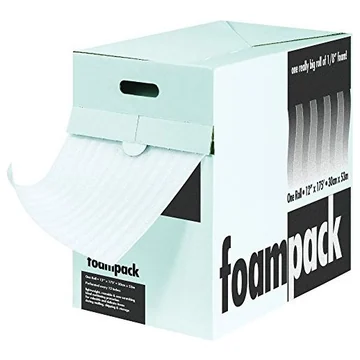
Most breakage happens because something moved inside the box. Void fill stops that. Crumpled kraft paper is the simplest fill: it is cheap, it recycles with the box and it can be torn to any amount. Indented kraft paper has a pressed pattern that adds cushion, and air foam rolls wrap fragile items in a soft layer.
Fill from the bottom. Put a layer of paper in the bottom of the box, set the heaviest item on it, then fill the sides and top until the item cannot move when you shake the closed box gently. Wrap each fragile item separately so they cannot knock into each other. For several flat items, a corrugated layer pad between them spreads the load.
If you need a lot of fill to stop the item moving, the box is too big. A smaller box, or a multi-depth box cut down, will protect better and ship cheaper than a big box stuffed with paper.
Some fills are better at some jobs. Paper is best for blocking and bracing, because it can be packed tight against heavy items. Air foam and bubble are best for wrapping surfaces that scratch, such as glass, polished metal and screens. Crinkle paper is mostly about presentation in gift boxes and does little to stop a heavy item moving. A mix often works best: paper to brace, a soft wrap against the surface that must not be marked.
In the catalog
How boxes fail, and how to stop it
Boxes rarely fail in mysterious ways. The bottom seam opens because the box was lifted from below with too much weight and too little tape. Corners crush because the box sat at the bottom of a stack with more weight on top than its board grade allows. Sides burst because the contents were packed tight and the box took a knock. Each of those has a fix that costs little.
For the bottom seam, tape the bottom before you pack, with the H pattern on anything heavy, and keep the weight within the box's rating: the Tape Logic 200#/ECT-32 boxes state up to 65 pounds. For crushed corners, use the board grade that matches the stacking, which is what the ECT number measures, and fill the box so the top does not sag. An underfilled box collapses under weight because the contents cannot support the lid.
For punctures and bursts, leave room for cushioning so the contents do not press on the walls, and choose a higher burst rating or double wall for sharp or dense contents. Damp is the quiet killer: corrugated board absorbs moisture and loses strength, so store flat boxes off the floor in a dry room, and do not leave packed boxes on a wet dock.
Reviews of the Tape Logic boxes show the same patterns from the buyer's side. Happy buyers mention sturdy board and true sizes. Unhappy ones mention flaps that do not meet, sizes a little over nominal and, on occasion, a thin batch. Measuring the first box from a new bundle against your item, before packing a whole order, catches most of those problems early.
Tape and labels finish the job
A good box with poor tape still fails at the seams. Seal the bottom first, before you pack, with a strip along the center seam running 2 to 3 inches up each end. Heavy boxes get the H pattern: the center strip plus a strip across each end seam. Use 2 inch tape at the least, and see how to choose packing tape for thickness and adhesive.
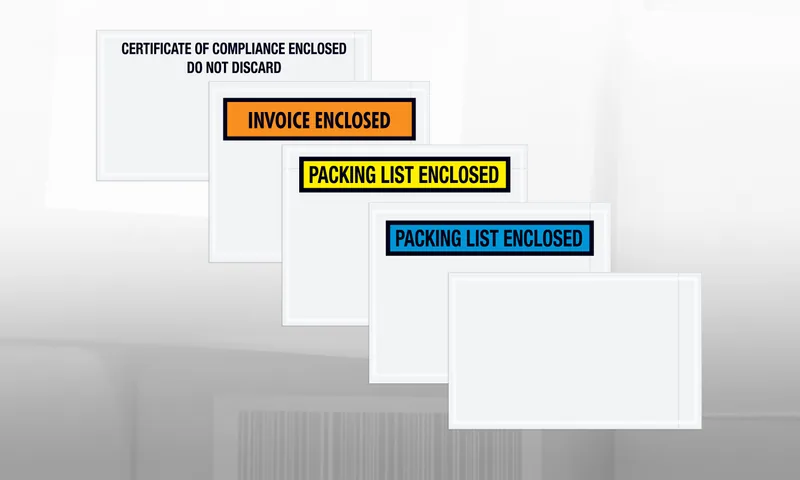
Labels go on the largest flat face, away from the tape seam. The Postal Service asks for all labels on the same side, not bent around edges, folded or overlapping. Handling labels such as Fragile or This Side Up go on more than one side so a handler sees them whichever way the box is turned; the guide to shipping and handling labels covers sizes and messages.
Before the box leaves, do a last check: does it bulge, rattle or give when pressed? If not, it is ready.
Recycling the box at the end
Corrugated boxes are one of the most recycled products in the country. The EPA's figures for 2018 put the recycling rate for corrugated boxes at 96.5 percent, far above most other packaging. Flatten the box, remove large amounts of foam or plastic fill, and it can go into the recycling with paper tape still attached.
Plastic tape is usually removed in the recycling process, but water-activated kraft tape recycles with the box itself, which is one reason some shippers prefer it. The Tape Logic kraft tape is described as 100% recyclable and repulpable.
“corrugated boxes had a recycling rate of 96.5 percent in 2018.”
Before a box goes to recycling, think about whether it can make one more trip. A sturdy box with clean corners that carried a light item is often fine for another light shipment or for storage, and the Tape Logic boxes are described as reusable as well as recyclable. When it does go, flatten it so it takes less room in the bin and in the truck.
Questions
What does ECT-32 mean on a box?
It is the edge crush test rating: the board withstands 32 pounds per inch of force on its edge, which predicts stacking strength. Most standard boxes from Tape Logic are 200#/ECT-32 single wall.
How much bigger than the item should the box be?
For sturdy items, just big enough to close the flaps without forcing. For fragile items, about 2 inches of cushioning on every side, so about 4 inches larger in each dimension.
When do I need a double wall box?
For heavy contents, boxes that will be stacked, long trips with several handoffs and items that cannot take a dent. The Tape Logic heavy-duty boxes are mostly 275# ECT-48 double wall.
How many boxes come in a bundle?
Tape Logic boxes come in bundles of 5 to 100 depending on size. Most standard sizes come 25 to a bundle.
Sources
- U.S. Postal Service, How to Send a Package, read October 23, 2026
- U.S. Environmental Protection Agency, Paper and Paperboard: Material-Specific Data, read October 23, 2026