Packing tape
How to choose packing tape: thickness, adhesive and width
Packing tape looks like a commodity until a box splits open on a conveyor. Four numbers decide how a roll behaves: thickness in mil, the adhesive, the width and the length. Here is how each one works, with real figures from the 64 acrylic and 41 hot melt Tape Logic models and the rest of the tape range.
Start with the box, not the tape
Before you compare rolls, think about the box the tape has to hold shut. Three things matter more than the brand on the core: how heavy the box is, how long it will stay sealed, and how cold or warm it gets between the packing table and the person who opens it. A 6 pound box of clothes that ships tomorrow and a 40 pound box of books that sits in a storage unit for two years need different tape, even if both are plain brown cartons.
Weight decides thickness. A heavier box puts more strain on the seam along the top, and thin tape can split down its length or tear at the edge where it folds over the side of the box. Time decides the adhesive. Some adhesives grab fast and hold well for weeks, others take a moment longer to set but keep their bond and their clarity for years. Temperature narrows the choice further, because every adhesive has a range in which it sticks properly.
The board matters too. A new, clean carton with a smooth surface is easy to seal. Recycled board is often rougher and dustier, and the adhesive has less to hold on to. Boxes that were already used once, or that sat in a dusty warehouse, behave like recycled board. If most of your boxes are like that, the adhesive question becomes more important than the thickness question.
Finally, count the boxes. If you seal five boxes a month, price per yard barely matters and convenience wins: a small pack and a simple gun. If you seal two hundred boxes a day, a cent per yard adds up, rolls that last longer save reloading time, and it may be worth matching tape to a case sealing machine. The rest of the choice follows from those four answers.
What mil means, and how thick is thick enough
Tape thickness is measured in mil, and one mil is one thousandth of an inch, 0.001 inch. That is not the same as millimeters: 2 mil is about 0.05 millimeters. The number includes the plastic film and the adhesive together, so two rolls of the same thickness can still feel different if one has a heavier adhesive coat and a thinner film.
Thin tape is not bad tape. The 1.6 mil rolls are made for light cartons, and for a box of clothes or paperwork they seal as well as a thicker roll at a lower price. The Tape Logic notes put it simply: lower mil for lighter cartons, mid-range for standard ones, higher mil for heavy ones. Where thin tape fails is under load. It stretches more, it can split along its length when a heavy box flexes, and it tears more easily when the seam is rubbed against other boxes.
As a working rule, 1.6 to 2 mil covers most boxes under about 20 pounds. Between 2.2 and 2.6 mil is the comfortable middle for mixed shipping, where some boxes are light and some are full of books or tools. The 3.5 mil rolls are for heavy, overstuffed or long-distance boxes, and for anyone who has had a box arrive with its tape split. Reviews of the thinnest rolls say the same in plain words: fine for average boxes, not heavy duty.
The thickness spread in the Tape Logic carton sealing tape runs from 1.6 to 3.5 mil in acrylic and 1.6 to 3 mil in hot melt. The cheapest yard in each thickness shows how little the step up from the thinnest roll usually adds.
| Thickness | Models | Lines | Lowest price per yard |
|---|---|---|---|
| 1.6 mil | 11 | Acrylic, Hot Melt | 2.9¢ |
| 1.8 mil | 6 | Acrylic | 4.0¢ |
| 1.9 mil | 7 | Hot Melt | 3.2¢ |
| 2 mil | 20 | Acrylic | 2.8¢ |
| 2.2 mil | 48 | Acrylic, Hot Melt, Natural Rubber, Colored, Pre-Printed | 2.6¢ |
| 2.5 mil | 7 | Hot Melt | 4.8¢ |
| 2.6 mil | 18 | Acrylic | 3.6¢ |
| 3 mil | 4 | Hot Melt | 6.0¢ |
| 3.5 mil | 8 | Acrylic | 5.5¢ |
Acrylic, hot melt or natural rubber
The adhesive is what actually holds the box shut, and carton sealing tape uses three main kinds. They differ in how fast they grab, how long they hold, how they cope with temperature and dirty board, and what they cost per yard.
Acrylic adhesive is the patient one. It takes a little longer to reach full grip, but it ages well, resists turning yellow and keeps its bond on boxes that sit for months. It is also the clearest of the three, which matters when tape runs over a shipping label or a barcode. Choose acrylic for storage, for moving boxes that may stay packed for a year, and for any box where the label underneath must stay readable. The Tape Logic acrylic models state an application range of 45°F to 120°F.
Hot melt adhesive is the fast one. It is made from synthetic rubber and resin, it sticks the moment it touches the box, and it holds well on overstuffed cartons. It also tends to cost the least per yard, so most busy packing lines use it. The Tape Logic hot melt models state application ranges of 32°F to 104°F and 45°F to 110°F, and the line includes a roll sold specifically as cold temperature tape. Hot melt is the default for shipping, as opposed to storing.
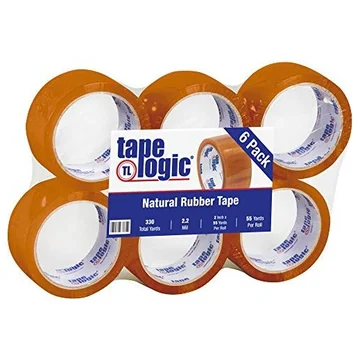
Natural rubber adhesive is the aggressive one. It soaks into the fibers of corrugated board quickly, so it grips recycled and dusty cartons where the other two can slip, and it needs less rubbing down after it is applied. It handles humidity well, and the Tape Logic natural rubber rolls state the widest application range of the three, 0°F to 150°F. That makes it the tape for unheated docks, trailers and hot attics, at a higher price per yard.
If you are unsure, the decision is short. Shipping within a few days in a heated room: hot melt. Storing, or taping over labels: acrylic. Cold, humid or dusty conditions, or recycled boxes: natural rubber.
| Adhesive | Models | Thickness | Stated application range | Lowest price per yard |
|---|---|---|---|---|
| Acrylic | 64 | 1.6–3.5 mil | 45°F to 120°F | 2.8¢ |
| Hot melt | 41 | 1.6–3 mil | 32°F to 110°F | 2.6¢ |
| Natural rubber | 4 | 2.2 mil | 0°F to 150°F | 4.7¢ |
In the catalog
Temperature is where good tape goes wrong
Most tape failures that look like bad tape are really temperature problems. Adhesive behaves like a thick liquid. In a warm room it flows into the tiny gaps of the board and grips. In the cold it stiffens and sits on top of the surface instead, so the tape looks stuck but peels off with little effort once the box is moved.
That is why the stated application range matters more than the adhesive's general reputation. The range is about the temperature when you apply the tape, and it is worth reading the low number in particular. Acrylic rolls that state 45°F will struggle on a loading dock in January. Hot melt rolls that state 32°F are fine in a cool warehouse but not in a freezer. Natural rubber rolls that state 0°F are made for exactly those cold places.
Once the tape is on and has bonded, it usually holds through a wider range than the one for application, because the adhesive has already flowed into the board. Problems start when cold tape is applied to cold boxes, so the simplest fix in winter is to keep the tape and the flat boxes in a heated room until you use them. If your packing area itself is cold, change the tape rather than fighting it.
Heat causes the opposite trouble. In a hot truck or attic, some adhesives soften and the tape can slide or lift at the edges. Boxes that will sit in the heat, such as stock stored in a garage over the summer, are better with acrylic or natural rubber, both of which state upper limits of 120°F and more.
2 inch or 3 inch, 55 yards or 110
Width is the most visible choice and the easiest. Two inch tape is the standard for shipping and fits the most common hand-held guns. The U.S. Postal Service's own packing advice asks for exactly that width, which tells you it is enough for ordinary parcels. Three inch tape covers more of the seam in one pass, which helps on wide, heavy or overstuffed boxes where the flaps do not meet neatly. The Tape Logic carton tape also comes in 4 inch and wider rolls for large cartons.
Length is a matter of how often you want to change rolls. Fifty-five yard rolls are light and easy for occasional use. One hundred ten yard rolls last twice as long in the same gun and usually cost less per yard. The 1,000 yard rolls are not for hand guns at all: they are made for case sealing machines on high-volume lines.
“Use enough 2-inch-wide packing tape to close and secure all seams.”
Price per yard is the fair way to compare. Divide the price of the pack by the total yards it holds, which is the roll length times the number of rolls. A 36 roll case of 110 yard tape holds 3,960 yards, so even a big case price can work out cheaper per yard than a small pack. Every model in the catalog shows its price per yard, and the cheapest yard for each roll size in the clear acrylic and hot melt lines follows.
Wider and longer rolls are not always the better buy. A 3 inch roll costs more per yard than a 2 inch roll of the same grade, and it needs its own 3 inch gun. If most of your boxes are small, the extra width is tape you pay for and do not need. Pick 3 inch for the heavy or awkward boxes and keep 2 inch for everything else.
| Roll size | Models | Lowest price per yard | Lowest-cost model |
|---|---|---|---|
| 2" × 55 yd | 31 | 3.5¢ | TLT90140018PK, 18 rolls |
| 2" × 110 yd | 24 | 2.6¢ | TLT902800, 36 rolls |
| 2" × 220 yd | 1 | 4.3¢ | TLT9022400, 36 rolls |
| 2" × 1000 yd | 5 | 3.2¢ | T903700, 6 rolls |
| 3" × 55 yd | 10 | 7.6¢ | T9051000, 24 rolls |
| 3" × 110 yd | 26 | 2.8¢ | TLT905400SK, 1080 rolls |
| 3" × 1000 yd | 3 | 7.3¢ | T9033700, 4 rolls |
| 4" × 72 yd | 4 | 5.7¢ | T921170, 18 rolls |
| 6" × 72 yd | 1 | 17¢ | TLT9236100, 12 rolls |
Clear, tan, colored or printed
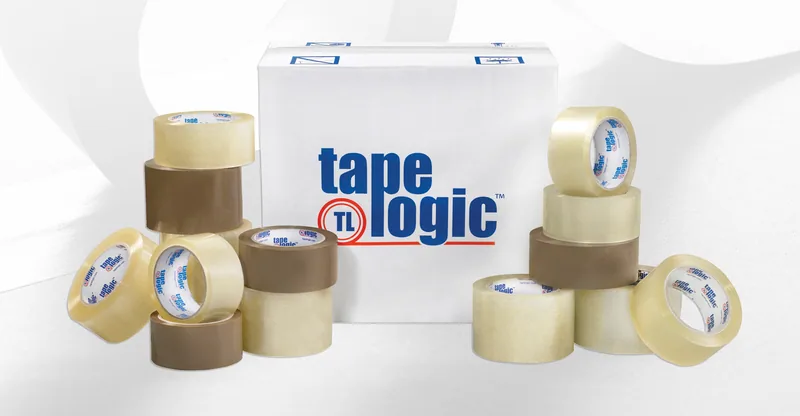
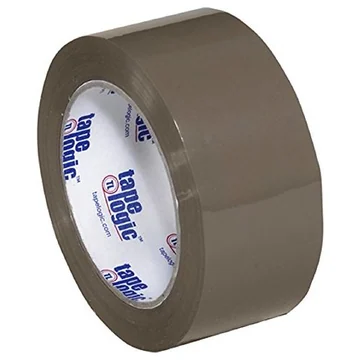
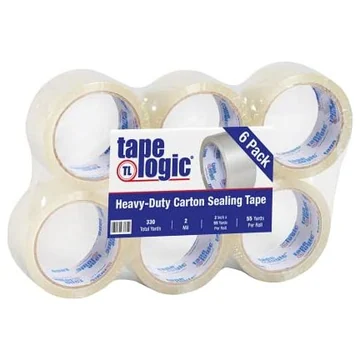
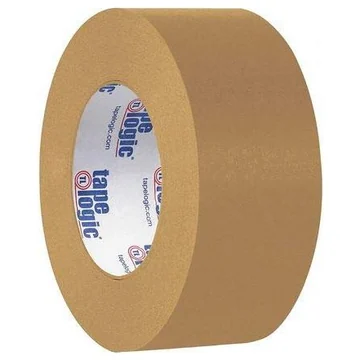
Most carton tape is clear or tan. Clear tape shows the box underneath and lets you tape over a label without hiding it. Tan tape blends with kraft board, so a box looks neater and repairs are less obvious. There is no strength difference between the two colors in the same grade, so the choice is about looks and labels.
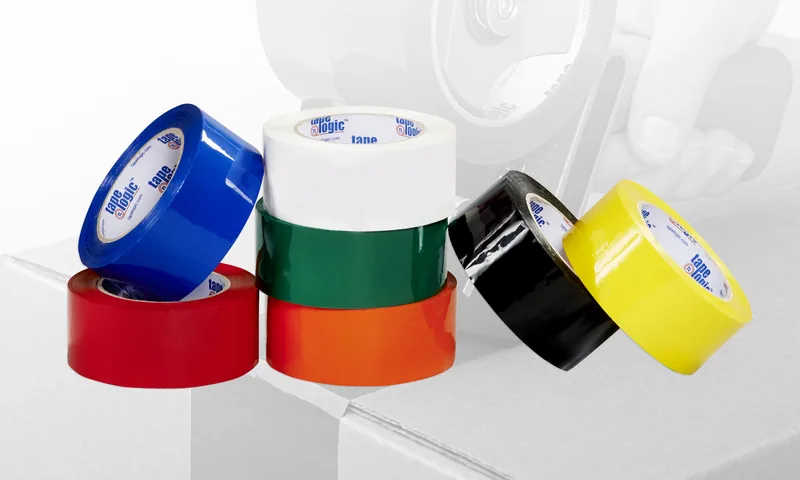
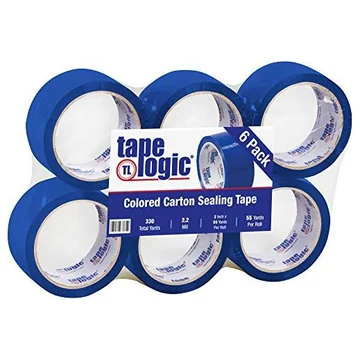
Colored tape adds information. A packing room can use one color for each carrier, a bright color for rush orders, or a color per customer or per warehouse zone. The Tape Logic colored tape comes in 8 colors, all 2.2 mil polypropylene with acrylic adhesive, in 2 and 3 inch widths. The color is visible from across a dock, which makes sorting faster than reading labels.
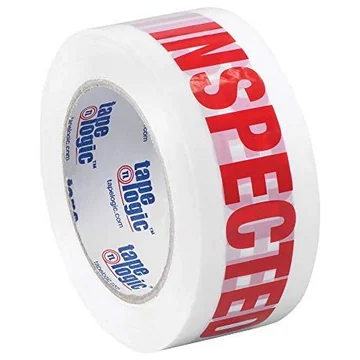
Pre-printed tape goes one step further and puts words on the seam. Fragile Handle with Care, Inspected, Packing List Enclosed, Do Not Double Stack and Stop If Seal Is Broken are among the Tape Logic messages. The message repeats along the roll, so it appears on every side the tape crosses, and it replaces a separate label. It makes sense when every box in a run needs the same instruction.
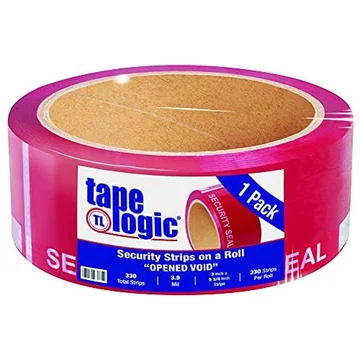
Security tape is a special case. When it is lifted, it leaves a visible OPENED VOID message on the box, so any attempt to open and reseal the parcel shows. The Tape Logic security strips are 3.9 mil and numbered every 5 3/4 inches, which lets you record a seal number for each shipment.
In the catalog
When paper tape beats plastic
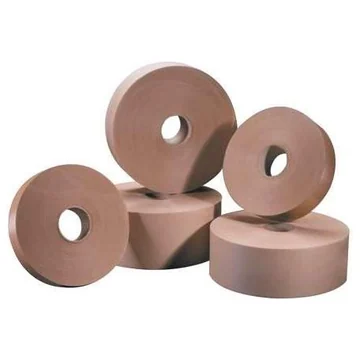
Water-activated tape, also called gummed tape, is paper with a starch adhesive that only becomes sticky when it is wet. It is applied with a paper tape dispenser that wets the tape and cuts it to length. Once applied, the adhesive soaks into the fibers of the box and dries into the board, so the seal is part of the carton rather than a layer on top.
That has three practical effects. It holds on dusty and dirty boxes where plastic tape struggles. It shows tampering clearly, because lifting the tape tears the surface of the box. And it recycles with the box, since the whole package is paper. The Tape Logic kraft tape is described as 100% recyclable and repulpable.
Gummed tape comes in two kinds. Non-reinforced tape is plain kraft paper for light cartons. Reinforced tape has fiberglass threads in the paper for strength and suits heavy boxes. The Tape Logic range has both, in widths from 1 1/2 to 3 inches and lengths of 375 to 1,000 feet, including rolls printed Fragile, Warning or Stop.
The catch is equipment. Without a dispenser that wets the tape evenly, gummed tape is slow and messy, so it suits a fixed packing station more than occasional use. If you want paper tape without water, flatback tape is the in-between option: a pressure-sensitive kraft tape that tears by hand and can be written on.
In the catalog
Choosing and loading a tape gun
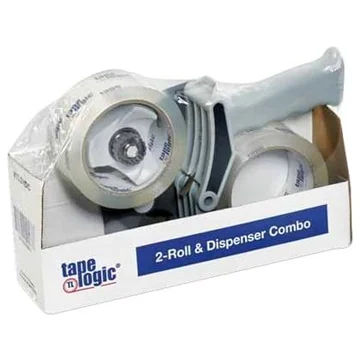
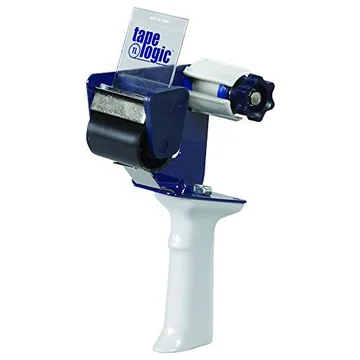
A hand-held tape gun turns a two-handed fight with a roll into one smooth pull. It holds the roll, presses the tape onto the box with a roller and cuts it with a blade at the end of the stroke. For anyone sealing more than a few boxes, it is the single biggest time saver.
The gun must match the tape. A 2 inch gun takes 2 inch tape, a 3 inch gun takes 3 inch tape, and a 4 inch gun takes 4 inch tape. Most carton tape is wound on a standard 3 inch core, and Tape Logic describes its rolls as fitting standard hand-held dispensers. Long-roll tape is the exception: it is wound on a 1 1/2 inch core to fit twice as much tape in the same diameter, and it needs a long-roll gun.

To load a gun, put the roll on the hub so the tape comes off the bottom of the roll toward the box. Thread the end under the roller and past the blade, then press it onto the box to start. If the tape comes off the top, it will run with the sticky side out and wrap around the roller. A tension knob, where the gun has one, sets how hard the roll pulls. Too loose and the tape sags, too tight and it stretches.
Heavier guns with metal frames last longer and hold the roll more steadily, which matters on a busy table. Guns with a retractable or guarded blade are safer when several people share a station. For a home move, a light gun sold with a few rolls is enough.
| Tape width | Guns and gun sets | Lowest price |
|---|---|---|
| 2" | 11 | $7.21 |
| 3" | 4 | $34.97 |
| 4" | 1 | $42.34 |
In the catalog
How to tape a box so it stays shut
The basic seal is one strip along the center seam where the flaps meet, running 2 to 3 inches down each end of the box. Those end tabs matter: a strip that stops at the edge of the top can peel back from the corner, while tape folded over onto the sides is pulled tighter as the box is handled.
For heavier boxes, use the H pattern. Run the center strip first, then a strip across each end of the top where the flaps meet the sides of the box. Seen from above, the three strips make a capital H. The same goes on the bottom, which carries the weight and is the seam most likely to fail. Many shippers also run a second strip along the center seam on very heavy boxes.
Press the tape down after it goes on. A gun's roller does this as you pull, but rubbing the tape along its length with your hand helps the adhesive flow into the board, especially with acrylic tape and on cool days. Natural rubber needs less of this, which is one of its selling points on a fast line.
Do not use tape to make up for a weak box. If a box bulges, has soft corners or was crushed in a previous trip, more tape will not save it. The Postal Service asks for packaging that does not bulge and is strong enough to protect the contents, and asks shippers not to wrap boxes in string or twine, which can catch in sorting machines.
Buying by the roll or by the case
Carton tape is sold from single rolls to cases of 36 and, at the top end, pallets of more than a thousand rolls. The bigger the pack, the lower the price per roll tends to be, but only up to a point, and only if you will use the tape before it gets in the way.
Clear 2 inch by 55 yard acrylic rolls make a good test case: line up the packs by size and the per-roll price stops falling somewhere in the middle. For a household or a small shop, a pack of 6 or 12 is usually the sensible size. A business that ships every day can save with a case of 36.
Tape keeps well if it is stored flat, out of direct sun and away from heat, in its box or a closed cabinet. Rolls that sit on their edge in a hot garage can deform and unwind unevenly. If you buy a large case, keep it with your flat boxes in the same room you pack in, so both are at room temperature when you use them.
Price changes over time, and so do pack offers, so compare by price per roll or per yard on the day you order rather than by pack size alone.
| Pack | Models | Lowest pack price | Per roll |
|---|---|---|---|
| 6 rolls | 5 | $19.51 | $3.25 |
| 12 rolls | 4 | $23.03 | $1.92 |
| 18 rolls | 2 | $34.49 | $1.92 |
| 36 rolls | 6 | $72.99 | $2.03 |
Reading a Tape Logic model number
The model number on a Tape Logic case is not random, and once you can read it, reordering the right tape takes seconds. In the carton sealing tape, the number starts with T9, and the next two digits give the roll format. T901 models are 2 inch by 55 yard rolls, T902 models are 2 inch by 110 yard rolls, T903 models are 1,000 yard machine rolls, and T905 models are 3 inch rolls.
The digits after that name the grade. In the catalog, 600 marks the 1.6 mil hot melt rolls, 700 the 1.9 mil hot melt, 800 the 2.2 mil hot melt and 900 the 2.5 mil hot melt. On the acrylic side, 170 is 1.8 mil, 220 is 2.2 mil, 291 is 2.6 mil and 350 is 3.5 mil. So T901600 is a 2 inch by 55 yard roll of 1.6 mil hot melt tape, and T902220 is a 2 inch by 110 yard roll of 2.2 mil acrylic.
Letters at the end add detail. A T means tan instead of clear, a letter such as R, B or W marks a colored roll, and a suffix such as 6PK means a pack of six rather than a full case. T9026006PK is therefore six rolls of the 2 inch by 110 yard #600 tape. The masking tape follows the same idea with its own digits: 2200, 2400 and 2600 are the general purpose, industrial and professional grades.
Type a model number into the search box and the matching model opens in its line, with the price and the rest of the specs. It is the fastest way to reorder exactly what is already on the shelf.
What the tape costs per box
Price per yard becomes concrete when you turn it into price per box. Measure how much tape one box uses. On a medium box, a strip along the seam with 3 inches down each end comes to about 3 to 4 feet, so top and bottom together take roughly 2 to 3 yards. The H pattern roughly doubles that.
Multiply by the price per yard of the roll you use. At about 2 cents a yard, a box sealed with 3 yards of tape costs around 6 cents in tape. With the H pattern, around 12 cents. Thicker tape might cost a cent or two more per box. Set against the price of a damaged item and a replacement, the difference between an economy roll and a heavy-duty roll is small on any box that matters.
The same arithmetic shows where economy tape makes sense: thousands of light boxes a month, where a fraction of a cent per box adds up and the boxes never come close to stressing the seam. For everything else, choosing the right thickness is cheap insurance.
A short checklist
Light boxes, shipped soon, in a warm room: 1.6 to 2 mil hot melt, 2 inch, in a standard gun. Heavy boxes: 2.6 to 3.5 mil, consider 3 inch tape and the H pattern. Boxes going into storage, or tape over labels: acrylic. Cold docks, trailers or recycled boxes: natural rubber, rated from 0°F. Proof against tampering: water-activated kraft tape or security strips.
Match the gun to the tape width and core. Compare by price per yard, not by pack price. Keep tape and boxes warm before use in winter. And when a box arrives split open, look at the thickness and the temperature before blaming the brand: most of the time, the roll was simply the wrong one for that job.
Questions
What thickness of packing tape is best for moving?
For moving boxes that will be stacked and may stay packed for months, 2.6 mil acrylic is a good middle choice. Heavy boxes of books or tools are better with 3.5 mil. Tape Logic acrylic rolls run 1.6 to 3.5 mil.
Is hot melt or acrylic tape better?
Hot melt carton sealing tape grabs faster and costs less per yard, so it suits shipping. Acrylic ages better and stays clear, and the Tape Logic acrylic rolls state 45°F to 120°F, so it suits storage in a heated room.
Can packing tape be used in the cold?
Only within its stated range. Tape Logic acrylic rolls state 45°F to 120°F, hot melt 32°F to 104°F or 45°F to 110°F, and natural rubber 0°F to 150°F.
How many boxes does one roll of tape seal?
A 55 yard roll is 165 feet. One strip along the top and bottom seams of a medium box uses about 8 to 10 feet, so a roll seals 15 to 20 boxes, and about half that with the H pattern.
Sources
- U.S. Postal Service, How to Send a Package, read October 23, 2026